
Standard Screen
Where digital print quality meets the rotary production floor, the SCREENOINDIA Standard Screen delivers fully loaded performance across four precision mesh configurations.
Where digital print quality meets the rotary production floor — the SCREENOINDIA Standard Screen delivers fully loaded performance across four precision mesh configurations, giving textile mills the resolution, open area, and structural consistency to print with complete confidence across every application type.
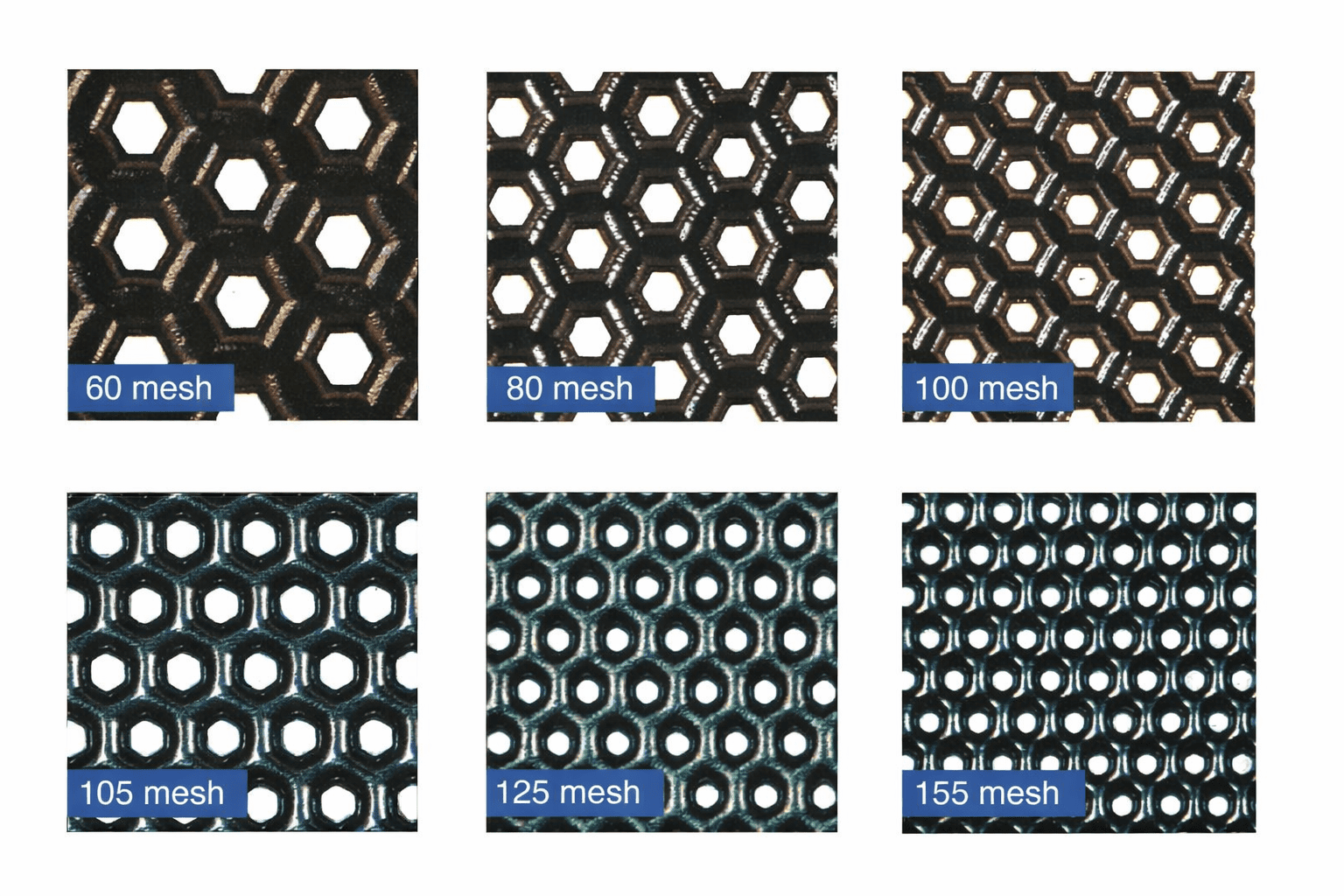
Standard nickel screen has dominated its field in ordinary printing on account of basic designs. Accurate precision can be done by them with even area, uniform thickness and identical repeats. Standard screens are trustworthy for you due to the consistent quality.
Suggested application:
Standard nickel screens are popularly used for rubble patch, sprinkle gold, big designs, outlines and deeper penetration. The printing fabric includes cretonne, flannel, coral velvet, plain cloth, plastic sheet etc.
Key performance advantages of Standard Screen:
Higher open area, larger hole geometry, and greater screen wall thickness across all configurations in the series
The highest available print resolution in textile rotary printing within this screen generation
Significantly improved surface printing output, driven by a substantially increased open area ratio Enhanced half-tone and geometrical print definition, enabled by a refined biconical hole profile that reduces moiré and pattern distortion.
135 ED Mesh Standard Screen
The 135 ED holds the widest hole geometry and the highest open area within the Standard Screen range, matched with an optimal wall thickness that allows a high volume of paste to move through the screen with minimal resistance. This makes it the most effective configuration for applications where even, uninterrupted coverage is the priority. It is particularly well-suited to white, gold, and metallic paste printing, where deposit consistency directly determines final print quality.
165 ED Standard Screen
The 165 ED is the versatile standard of the Third Generation range, a balanced, reliable configuration built to perform consistently across the broadest range of production applications. From clean fine lines to solid blotch areas, it handles varied design types without requiring a screen change between jobs. For production floors that print across a wide range of design briefs, this is the mesh count that delivers repeatable results day in, day out.
195 ED Mesh Standard Screen
Higher mesh count directly translates to sharper print definition, and the 195 ED has been engineered to make the most of that relationship. By combining a higher mesh count with a proportionately larger hole geometry at a maintained optimal wall thickness, this screen achieves consistently high output quality across the most technically demanding print categories: half-tone work, geometrical designs, fine line reproduction, multi-colour combinations, and biconical hole design printing.
195 S Mesh Standard Screen
With an open area of 20%, the 195 S is purpose-built for production scenarios that demand superior resolution and reliable paste transfer to high-volume substrates. It delivers measurable improvements across three specific application categories:
Half-tones noticeably improved resolution in tonal gradation and shade impression accuracy
Geometrical and fine lines cleaner, more defined edges, with improved straightness in printed shapes
Reactive printing, with higher volumetric paste transfer, ensures thorough penetration into the substrate, preventing the superficial unprinted spots that can appear after washing.
The defining characteristic of this series is its capacity to handle design requirements at resolutions that were previously unachievable in rotary printing — eliminating saw tooth effects in fine lines, removing moiré patterns in half-tone work, and enabling multi-colour combinations across diverse design types.
This screen delivers four clear performance advantages:
1. The highest print resolution currently achievable in textile rotary screen printing
2. Superior surface printing output through exceptional fine-detail definition
3. Significantly improved half-tone and geometrical print performance, with an advanced biconical hole geometry that further reduces moiré and pattern distortion
4. The capability to take on the most technically demanding design briefs in rotary printing — without compromise
| Repeat (mm) | Length (mm) | Mesh | Thickness (mm) | Open Area (%) |
|---|---|---|---|---|
| 640 | 1280-3500 | 25 | 0.135-0.140 | 35 |
| 30 | 0.130-0.135 | 30 | ||
| 40 | 0.125-0.130 | 25 | ||
| 60 | 0.115-0.120 | 20 | ||
| 80 | 0.110-0.115 | 18 | ||
| 100 | 0.105-0.110 | 16 | ||
| 105 | 0.105-0.110 | 16 | ||
| 110 | 0.105-0.110 | 16 | ||
| 125 | 0.105-0.110 | 15 | ||
| 125V | 0.105-0.110 | 15 | ||
| 820 | 1280-3500 | 25 | 0.140-0.145 | 35 |
| 30 | 0.135-0.140 | 30 | ||
| 40 | 0.130-0.135 | 25 | ||
| 60 | 0.120-0.125 | 20 | ||
| 80 | 0.115-0.120 | 18 | ||
| 100 | 0.110-0.115 | 16 | ||
| 105 | 0.110-0.115 | 16 | ||
| 110 | 0.110-0.115 | 16 | ||
| 125 | 0.110-0.115 | 15 | ||
| 125V | 0.110-0.115 | 15 | ||
| 914 | 1280-3500 | 25 | 0.140-0.145 | 35 |
| 30 | 0.135-0.140 | 30 | ||
| 40 | 0.130-0.135 | 25 | ||
| 60 | 0.120-0.125 | 20 | ||
| 80 | 0.115-0.120 | 18 | ||
| 100 | 0.110-0.115 | 16 | ||
| 105 | 0.110-0.115 | 16 | ||
| 110 | 0.110-0.115 | 16 | ||
| 125 | 0.110-0.115 | 15 | ||
| 125V | 0.110-0.115 | 15 | ||
| 1018 | 1280-3500 | 25 | 0.145-0.150 | 35 |
| 30 | 0.140-0.145 | 30 | ||
| 40 | 0.135-0.140 | 25 | ||
| 60 | 0.120-0.125 | 20 | ||
| 80 | 0.120-0.125 | 18 | ||
| 100 | 0.115-0.120 | 16 | ||
| 105 | 0.115-0.120 | 16 | ||
| 110 | 0.115-0.120 | 16 | ||
| 125 | 0.115-0.120 | 15 | ||
| 125V | 0.115-0.120 | 15 |
Screen Parameters
To fully appreciate the performance advantages of the Standard Screen series, it is essential to understand how the core screen characteristics interact; open area, mesh count, and screen wall thickness are closely interdependent, and the relationship between them determines how a screen performs in production.
This interdependency is a direct consequence of the nickel growth that takes place during the electroforming process. In simple terms, as mesh count increases and screen wall thickness rises, the available open area decreases. During electroforming, nickel deposits grow outward from the mandrel in two directions simultaneously, upward and laterally.
Through 10+ years of concentrated development in electroforming chemistry, SCREENOINDIA has refined the process to direct nickel growth predominantly in the vertical direction. This produces a dam geometry that stays narrow and well-defined, allowing the relationship between hole size, mesh count, and wall thickness to be optimised beyond the standard limits of the rotary screen printing industry.
The practical result is clear: a narrower dam and a higher open area produce an exponential improvement in screen printability. Less impression pressure is needed to achieve consistent substrate coverage. Paste consumption is reduced. And the Standard Screen perform at the highest level for both full penetrative and surface printing applications — consistently delivering the finest print resolution available in textile rotary printing at this stage of screen development.
Precision Engineered for Every Print
India and international markets where quality is never a compromise.